More than 70,000 deaths in Gaza cast a long shadow over Tuesday's Israeli vote
Voters head to the polls in a tight 120-seat race defined by Benjamin Netanyahu's 19-year grip on power and a challenge from former army chief Gadi Eisenkot.
By Andrew Fletcher ·
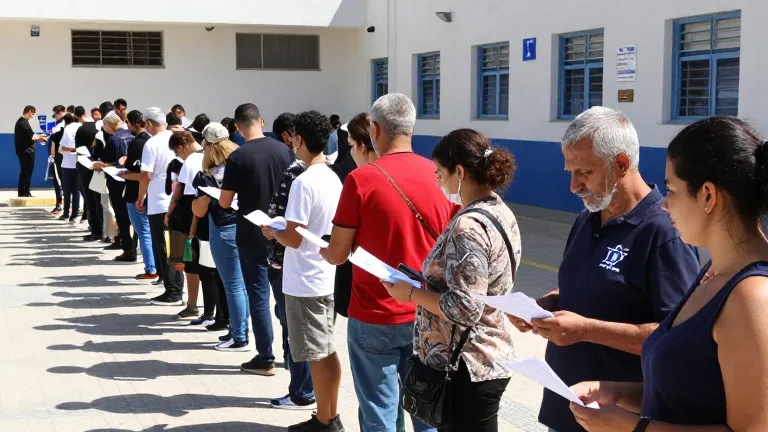
Israelis went to the polls on Tuesday to choose a government in a contest that centers on one man rather than traditional left-right divisions.
Benjamin Netanyahu first took office three decades ago and has served as prime minister for 19 of the last 30 years. His opponents describe the election as a referendum on his leadership rather than a standard policy debate. Polls indicate the pro-Netanyahu and anti-Netanyahu blocs are running close.
The leading challenger is Gadi Eisenkot, a former Israel Defense Forces chief of staff who entered politics four years ago. Eisenkot leads the Yashar party, a name that translates to straight or direct. He advocates for US-style term limits for the prime minister, citing the corrupting nature of power.
Netanyahu's war in Gaza has resulted in the death of more than 70,000 Palestinians. Israel states that a third of those killed were Hamas combatants. The conflict failed to eliminate Hamas and has damaged Israel's international standing. Netanyahu also faces an ongoing corruption trial and the aftermath of his judicial overhaul attempts.
Opposition leaders have framed their campaign around accountability. Oded Levi, who voted for Netanyahu in 2022, attended an Eisenkot rally to express his view that the current prime minister remains responsible for the events of 7 October 2023. Eisenkot's campaign emphasizes action over rhetoric, appealing to voters tired of political showmanship.
Netanyahu's campaign uses rhyming posters to contrast the right with Palestine. His team places opposition leaders alongside the heads of parties representing Palestinian citizens of Israel, who comprise about a fifth of the population. Pro-Netanyahu media outlets have kept his opponents on the defensive in the closing weeks.
The outcome may hinge on a single seat in the 120-member Knesset. Many liberal and secular expatriate Israelis are traveling home to vote, a group not captured by standard polls. A state ceremony marking the 1995 assassination of Yitzhak Rabin saw Netanyahu send a low-ranking minister in his place.
Eisenkot's allies see his restraint in response to a recent slur on Channel 14 as a strength. The race is expected to be decided by coalition building in the weeks following the vote, with Eisenkot's party hoping to outmaneuver the entrenched network of Netanyahu's loyal base.
Source: The Guardian